
01
Local by default
One binary serves the registry, API, Xet storage, and web UI. It binds to loopback and keeps your workshop private.
Local-first model registry
A writable, Hugging Face-compatible registry for the models and adapters you train and keep. Import, inspect, version, and reuse them with the tools already in your workflow.
One self-contained binary · Linux & macOS
$ curl -fsSL https://miniface.co/install.sh | sh
Installed Miniface to ~/.local/bin/miniface
$ miniface
Registry listening at http://127.0.0.1:8080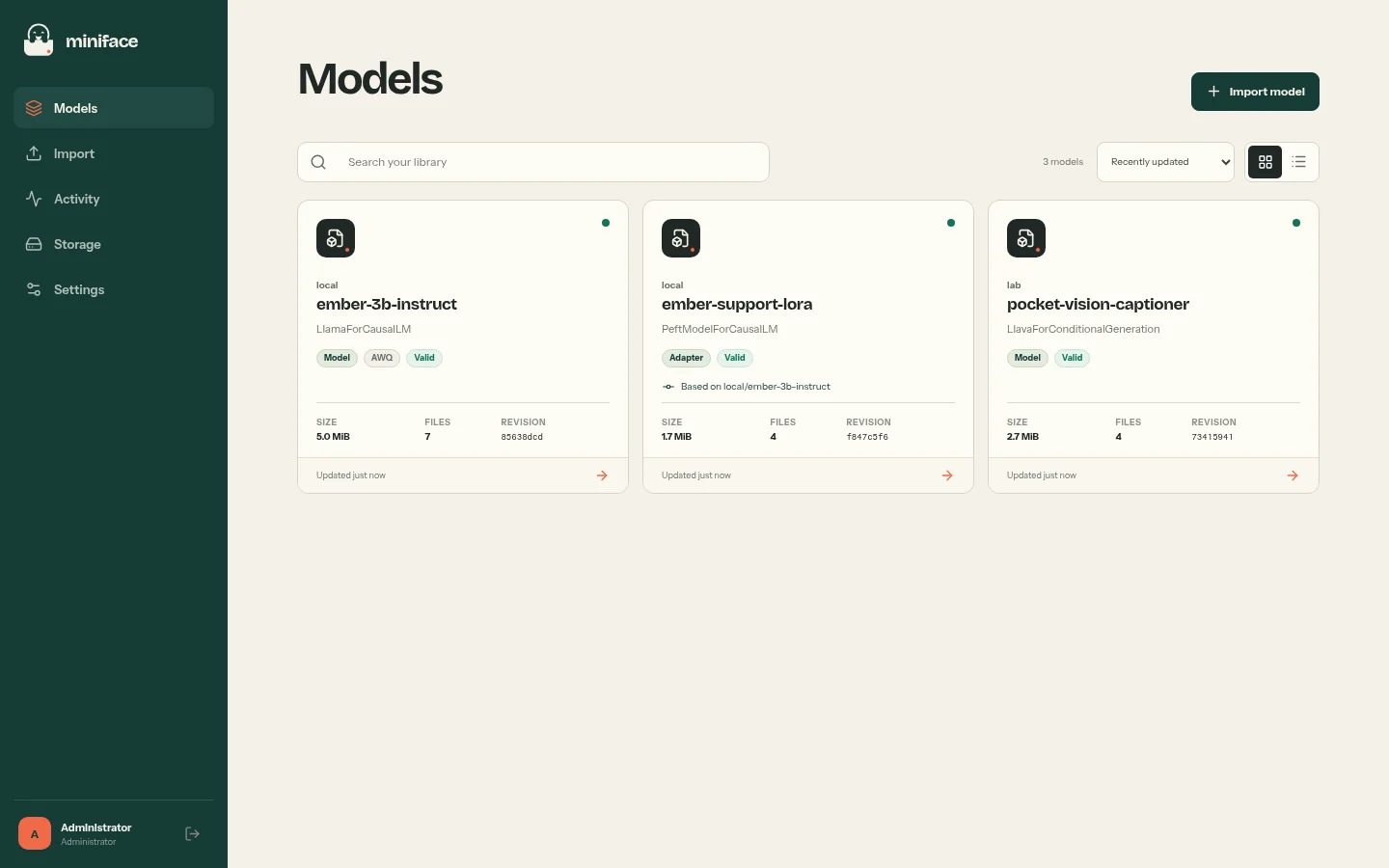
Your private model workshop. Everything you need to find, inspect, and use a model. Nothing you don’t.
Runs on your machineUse the tools already in your workflow
Where Miniface fits
Unsloth and PEFT fine-tune models. Ollama and vLLM run them. Unlike a download cache, Miniface is a writable local registry for versioned model repositories, adapters, and provenance.
Small on purpose
Miniface keeps the useful slice of a model hub close: repositories, immutable revisions, storage, and client compatibility.
01
One binary serves the registry, API, Xet storage, and web UI. It binds to loopback and keeps your workshop private.
02
Imports and uploads become immutable snapshots. Copy an exact revision into CLI, Transformers, PEFT, or Unsloth.
03
Large model files use chunked, deduplicated storage. Shared weights take less physical space without changing logical files.
The whole loop
Keep training where it belongs. Miniface gives the artifacts around it a dependable home.
Import a local folder or mirror a pinned model directly from Hugging Face.
Fine-tune with Unsloth, TRL, PEFT, or the training code you already use.
Upload adapters or merged weights with the familiar Hugging Face client API.
Pin both adapter and base-model revisions for a reproducible local workflow.
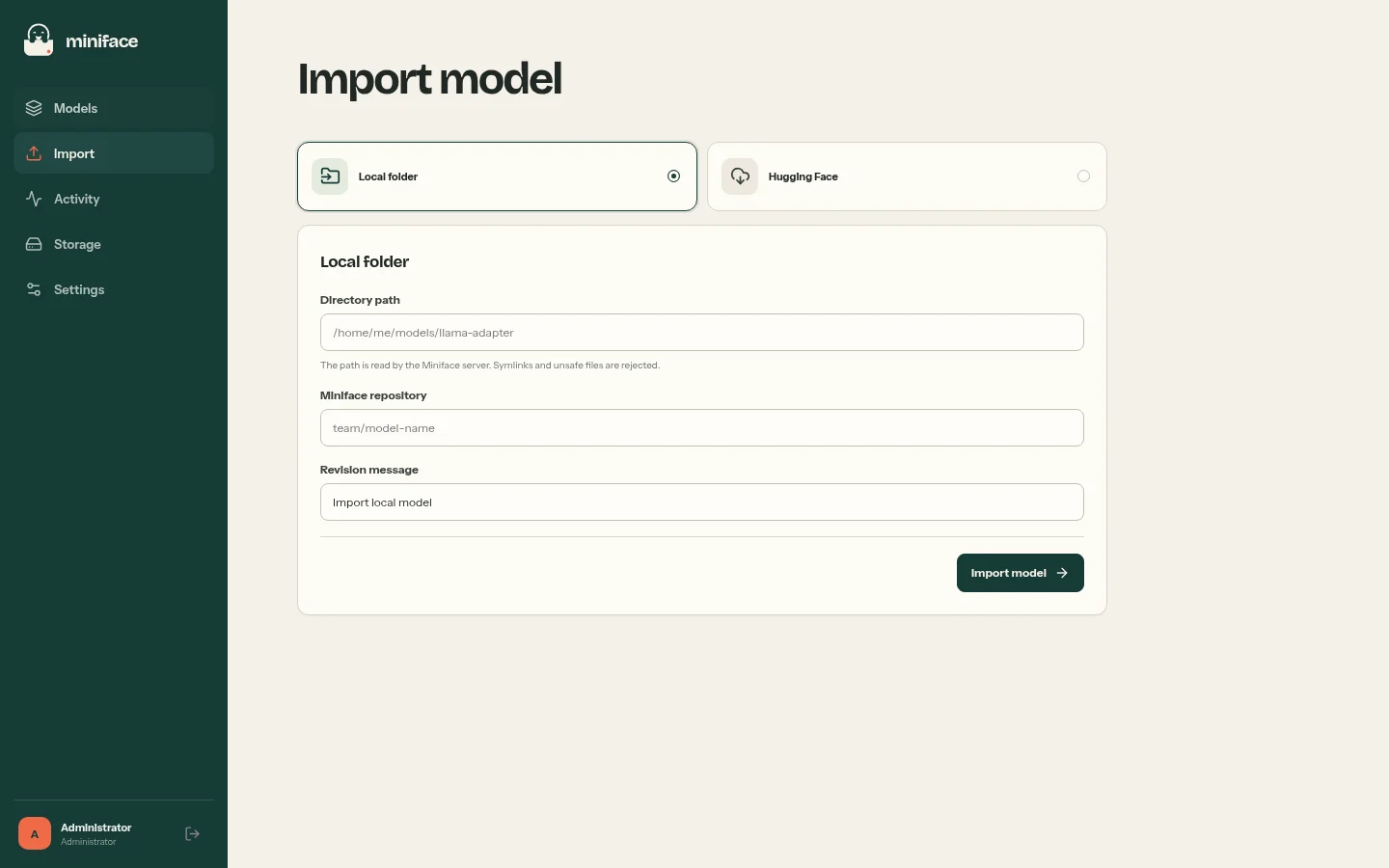
Import
Point Miniface at a local directory, or search and mirror a public, private, or gated repository at an immutable source revision.
Inspect & use
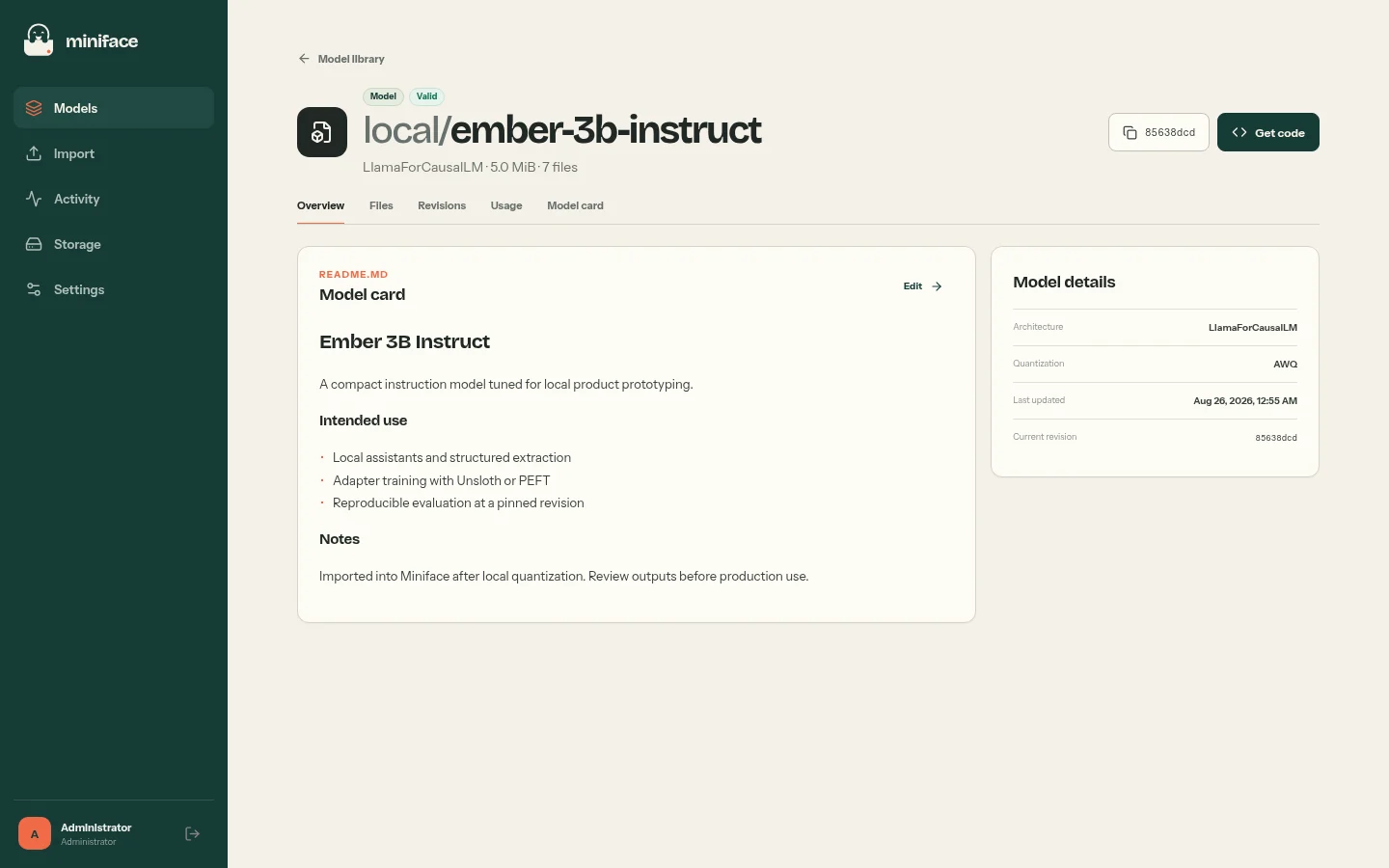
See architecture, quantization, files, provenance, and revision history. Then copy a pinned snippet for the tool you need.
Familiar clients
Miniface implements the model APIs your existing tools expect. Set two environment variables, then work with local repositories by ID and revision.
# Point Hugging Face clients at Miniface
export HF_ENDPOINT=http://127.0.0.1:8080
export HF_TOKEN=mf_pat_your_token

# Download one immutable snapshot
hf download local/ember-3b \
  --revision 4e7c2b9d…
Focused by design
Miniface is a single-administrator registry designed to run locally. It does not try to be a hosted social hub, training scheduler, or Internet-facing multi-user service.
Ready when you are
Install the binary, run miniface, and open your private registry.
curl -fsSL https://miniface.co/install.sh | sh
Downloads a checksum-verified release from GitHub. Review the install script first if you prefer.